
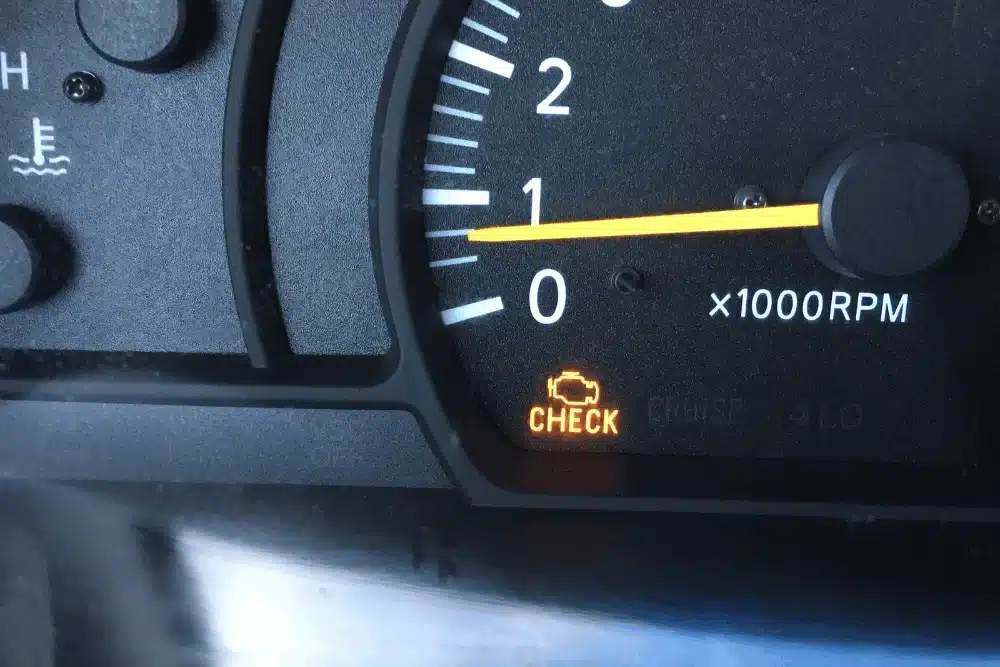
A check engine light does not mean your engine is failing. It means your vehicle caught something and flagged it, and the next step is figuring out why. At 2nd Mile Repair, the go-to engine diagnostic shop for drivers in Canadian Lakes, MI and across Mecosta County, that next step involves a lot more than a code reader. This post breaks down what your check engine light is really communicating, why the free scan at the parts store rarely gives you the full picture, what advanced diagnostic tools like Pico scopes and pressure transducers actually reveal, and how to know when to pull over immediately versus when you can schedule a visit.
The Check Engine Light Is a Clue, Not a Diagnosis
Here is the truth most people do not hear enough: your check engine light does not tell you what is wrong. It tells you that your vehicle’s onboard computer has detected something outside of its expected parameters. That is it.
Think of it like a smoke alarm going off in your house. The alarm tells you something is wrong. It does not tell you where the fire is, how big it is, or whether it is even a fire at all. Your engine light works the same way.
A stored diagnostic trouble code (DTC) gives a technician a starting point. But the code is tied to a symptom, not a root cause. Misfire codes, oxygen sensor codes, evap system codes, and lean fuel mixture codes all require follow-up testing to understand what actually triggered them. Skipping that step is how shops end up replacing parts that were never the problem.
Free Code Reads vs. Real Vehicle Diagnostics: What’s the Difference?
Auto parts stores offer free code reads as a way to get you in the door. But there is a massive gap between pulling a code and diagnosing a vehicle. Here is what that difference actually looks like:
| What You Get | Free Code Read at Parts Store | Real Diagnostic at 2nd Mile Repair |
|---|---|---|
| Trouble Codes Retrieved | Yes | Yes |
| Root Cause Identified | No | Yes |
| Live Data Analysis | No | Yes |
| Component-Level Testing | No | Yes |
| Advanced Scope Testing | No | Yes (Pico scopes) |
| Repair Recommendation | Guess based on code | Evidence-based diagnosis |
| Risk of Unnecessary Parts | High | Low |
The free code read is not worthless. But it is the first step in a much longer process. Treating it like the final answer is where things go wrong.
What a Diagnostic Specialist Actually Does in Mecosta County
At 2nd Mile Repair, the diagnostic process is not a single tool or a single scan. It is a methodical investigation using a collection of advanced equipment that most shops in the area do not have access to.
Pico Scopes for Electrical and Signal Testing
When a vehicle has complex electrical problems, standard scan tools often fall short. A Pico scope is an oscilloscope that reads electrical signals in real time, displaying them as waveforms that show exactly how a sensor, injector, or actuator is performing. This allows a technician to see signal behavior that a standard scan tool simply cannot detect. This is how intermittent faults and hard-to-replicate issues get caught.
Pressure Transducers for Mechanical Diagnosis
Engine misfires, rough idle, and poor performance are not always electrical problems. A pressure transducer measures real-time pressure variations through access points like the spark plug port, exhaust manifold, intake manifold, or fuel rail. This reveals compression issues, valve timing problems, exhaust restrictions, and fuel delivery faults that a code reader simply cannot detect.
High-Tech Listening Devices for Hard-to-Find Noises
Some problems announce themselves through sound. Ticking lifters, bearing noise, and fuel system buzz can be almost impossible to isolate by ear in a noisy shop. High-tech listening devices pinpoint the exact source of a sound, which saves time and prevents the wrong component from being replaced.
When your check engine light comes on in the Canadian Lakes, MI area, this is the kind of process that gets you an accurate answer instead of a parts-swapping guessing game.
Why Guesswork Repairs Cost You More
One of the most frustrating experiences a vehicle owner can have is paying for a repair that does not fix the problem. It happens more than it should, and it almost always comes down to an incomplete diagnostic process.
Here is how that cycle typically plays out:
- Check engine light comes on
- Codes pulled, most likely cause assumed
- Part replaced based on the code alone
- Light comes back on within days or weeks
- Repeat
Every unnecessary part you pay for is money that should have gone toward fixing the actual root cause. A proper diagnosis upfront costs less than two or three rounds of replacing parts that were not the problem.
This is especially true for vehicles with high mileage or multiple stored codes. The more miles on the clock, the more likely a single symptom has more than one contributing factor. Skipping thorough testing in those cases almost guarantees a return visit.
Is This Check Engine Light Urgent? Knowing When to Act Fast in Canadian Lakes
Not every check engine light demands pulling over immediately. But some do. Here is how to read the situation:
Solid check engine light:
- Stay aware, but you can drive with caution to a shop
- Avoid heavy towing or hauling until a technician can assess the issue
- Get it diagnosed soon, not next month
Flashing check engine light:
- This is an active misfire severe enough to damage your catalytic converter
- Pull over when it is safe to do so
- Do not continue driving until you have a diagnosis
Check engine light alongside other warning lights (oil, temperature, brake):
- Take this seriously immediately
- Multiple warning lights together often signal a more serious underlying issue
If your check engine light is on and you are near Canadian Lakes, Big Rapids, or Stanwood, do not ignore it. A quick diagnosis now prevents a much larger repair bill later.
Why 2nd Mile Repair Handles Check Engine Diagnostics Differently
Most shops in the area can pull a code. Far fewer have the tools, training, and commitment to find out what the code actually means.
2nd Mile Repair is a Michigan Master Tech Certified shop in Canadian Lakes, MI, serving drivers across Mecosta County, Tullymore, Stanwood, and Big Rapids. The approach here is built on honest communication, quality workmanship, and a diagnostic process that does not skip steps.
- Michigan Master Tech Certification: Our technicians hold Michigan Master Automobile Mechanic certification, a state-issued credential from the Michigan Secretary of State that requires passing exams across all major vehicle repair categories. It is one of the highest standards a technician can hold in the state.
- Advanced Diagnostic Equipment: Pico scopes, pressure transducers, and high-tech listening devices allow for component-level testing that goes well beyond generic scan tools.
- 2-Year/24,000-Mile Warranty: Repairs are backed by a 2-year/24,000-mile warranty, with a 3-year/36,000-mile warranty on drivetrain and engine work.
- Transparent Process: Every vehicle gets a full Digital Vehicle Inspection, so you see exactly what was found and what was recommended before any work begins.
- Honest Communication: No upselling, no unnecessary parts, no guessing. Just a clear explanation of what the vehicle needs and why.
FAQs About Check Engine Light and Vehicle Diagnostics
Is it safe to drive with my check engine light on?
A solid check engine light generally means you can drive cautiously to a repair shop, but you should not ignore it for long. If the light is flashing, pull over safely as soon as possible because a flashing light often signals an active misfire that can damage your catalytic converter.
Why is my check engine light flashing?
A flashing check engine light typically means the engine is misfiring severely enough to cause catalytic converter damage. This is different from a steady light and should be treated as an urgent issue requiring immediate professional attention, not a situation to put off until later.
What is the difference between a free code pull and a real diagnostic?
A free code pull retrieves a stored fault code, which only identifies a symptom, not the root cause. A real diagnostic involves live data analysis, component-level testing, and advanced tools like oscilloscopes and pressure transducers to pinpoint exactly what failed and why.
How do mechanics diagnose complex electrical problems?
Technicians use specialized tools like Pico scopes to display live electrical signals from sensors, injectors, and actuators as real-time waveforms. This allows them to see exactly how a component is performing, rather than relying on fault codes alone, which often cannot detect intermittent electrical faults.
Will a loose gas cap cause the check engine light to turn on?
Yes, a loose or missing gas cap is one of the most common triggers for an evaporative emission system code, which turns on the check engine light. Tightening the cap may resolve the issue, but the light will not clear until the vehicle’s EVAP monitor completes a full retest, which can take several drive cycles under the right conditions. If the light stays on, bring your vehicle to 2nd Mile Repair for a proper diagnosis to rule out a more serious leak in the evap system.
Schedule Your Check Engine Light Diagnostic in Canadian Lakes, MI Today
Your check engine light is not something to sit on. The longer an undiagnosed issue runs, the more damage it can cause to other systems. At 2nd Mile Repair, you get a real diagnostic from a specialist who uses the tools and testing methods to find the actual root cause, not just a best guess.
Schedule your engine diagnostics appointment with 2nd Mile Repair, located at 6777 S 130th Ave, Canadian Lakes, MI 49346. Call us at (231) 867-0550. We also serve drivers from Stanwood, Tullymore, Big Rapids, and throughout Mecosta County.